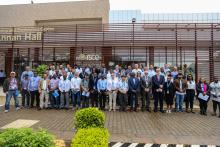
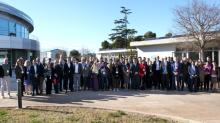
Regional Partnerships for the UN’s Digital Transformation: The Advanced FRIM Capacity Building Workshop, Regional Service Centre Entebbe (RSCE), 13-17 November
The United Nations system is engaged in a digital transformation. However, technology alone is not enough. Building the capacity of staff to take full advantage of new technological tools is critical. The United Nations Global Service Centre (UNGSC) is supporting this process, working closely with field missions and other partners to tailor digital technology solutions to their unique needs and ensuring they possess the skillsets to utilize them.
UNGSC marks UN Day 2023: Towards a more inclusive, innovative, and peaceful future
“The United Nations is a reflection of the world as it is – and an aspiration of the world we know it can be.” –UN Secretary-General António Guterres
On this UN Day, the United Nations Global Service Centre (UNGSC) is inviting stakeholders across the UN system and beyond in Brindisi, Italy, and Valencia, Spain, to join forces and accelerate the implementation of the UN’s goals through innovation and collaboration.
Robotics Competition: Schools across Valencia, Spain, will mark UN Day by building robots that respond to the needs of UN field missions.
The UN is increasingly exploring using robots for surveillance, security, and humanitarian operations, with several pilot projects underway.
On 24 October 2023, UN Day, the United Nations Global Service Centre, a pioneer in transformative technologies for the UN System, will bring this timely field to the public, engaging youth and civil society in a deeper understanding of technology, peace, and development.
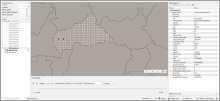
“Towards a Conflict Early-Warning System: UNGSC-ESADE Project”
Predictive analysis can significantly enhance strategic planning and monitoring in peacekeeping operations. In his article “Machine Learning and Conflict Prediction,”* Chris Perry notes, the development of a “robust, accurate and effective conflict early warning system” has long been a priority for the United Nations.
To that end, as part of UNGSC’s Academia Partnership Programme, students from Barcelona’s ESADE University have developed a novel data model.
Supporting the drawdown and closure of the United Nations Multidimensional Integrated Stabilization Mission in Mali (MINUSMA)
Following the adoption of UN Security Council resolution S/RES/2690 (2023), terminating a decade-long UN peacekeeping mission in Mali, the United Nations Global Service Centre (UNGSC) will provide on-site and remote support for the Mission’s drawdown and liquidation.
Ministers of Foreign Affairs of Italy, Bulgaria, and North Macedonia visit the United Nations Global Service Centre, Brindisi.
The United Nations Global Service Centre (UNGSC) was pleased to welcome the Foreign Ministers of Italy, H. E. Antonio Tajani, of Bulgaria, H.E. Mariya Gabriel, and of North Macedonia, H.E. Bujar Osmani, for a presentation and tour of the Organization’s Base.
Director of UNGSC, Giovanna Ceglie, was joined by Walid Ibrahim, Coordinator of the United Nations Humanitarian Response Depot / World Food Programme (UNHRD /WFP), a co-located entity on the UNGSC Brindisi base, in greeting the delegation.
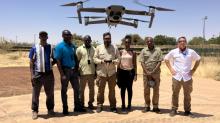
Life-saving know-how: UNGSC-UNCAP MINUSMA Drone Training
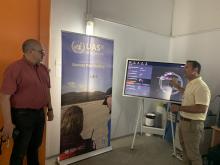
Uncrewed Aircraft System (UAS) training is critical to identifying potential risks, improving real-time situational awareness, preventing ambushes, and saving lives. The United Nations Global Service Centre (UNGSC) provides this vital know-how on-site for Peace Operations, as well as other UN entities, through a partnership with the UN Command, Control, Communications, Computers Intelligence, Surveillance and Reconnaissance (C4ISR) Academy for Peace Operations (UNCAP).
UNGSC launches Autonomous Surveillance System Proof of Concept
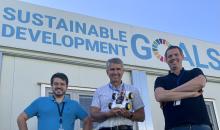
Smart technologies can be instrumental in achieving the United Nations’ Sustainable Development Goals (SDGs), in particular, SDG #9, which calls for building resilient infrastructure and fostering innovation.
Autonomous indoor drones present vast potential in this regard. Equipped with sensors and cameras, they can navigate complex indoor spaces, conduct tasks without human intervention, and detect irregularities, triggering immediate responses to avert major incidents.