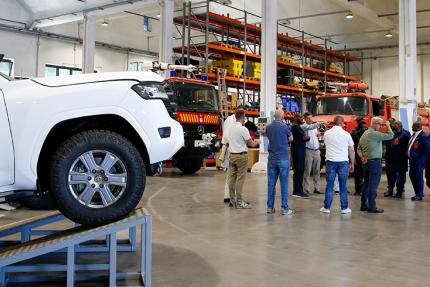
From 23 to 26 February 2026, the United Nations Global Service Centre (UNGSC), in collaboration with the Office of Information and Communications Technology (OICT) and partners across Headquarters and field missions, convened the 4th Annual Data and Visualization Workshop: From Governance to Operations. Bringing together geospatial experts, data officers, and operational stakeholders from across peace operations, the workshop marked a significant step in translating policy frameworks into practical, mission-ready implementation.
Turning Strategy into Operational Reality
This year’s workshop directly reflected the priorities of the Geodata and GeoVisualization Working Groups Roadmap, which aims to establish a standardized, collaborative, and interoperable geospatial ecosystem aligned with the UN Data Strategy and UN Geospatial Strategy. Over four days, participants moved beyond conceptual discussions and focused on operationalization: how governance, metadata, data quality, and custodianship frameworks within daily workflows support field missions.
Sessions addressed:
- Integration of geospatial assets into the UN Data Catalogue
- Practical implementation of geospatial data governance
- Hands-on application of the Data Quality Framework
- COGI data maintenance workflows
- Metadata onboarding and catalogue guidelines
- DevOps, automation, and dynamic web mapping
- AI applications for mapping, Digital Twin, and image acquisition
The programme's structure, combining policy-level presentations with practical demonstrations and field mission case studies, reinforced the workshop’s central theme: governance must serve operations.
Strengthening the Geospatial Community
The workshop also reaffirmed the mandate of the Geodata and GeoVisualization Working Group: to develop best practices, strengthen custodianship, enhance interoperability, and foster knowledge sharing across missions and Headquarters. The Geospatial community shared applied experiences, demonstrating how standardized workflows and quality-controlled datasets directly improve operational mapping, situational awareness, and decision support including contributions to Unite Aware and mission operations. Importantly, the event highlighted the evolution of the geospatial community from isolated technical functions toward a coordinated, governance-driven network with shared standards, shared tools, and shared accountability.
Data, Visualization and AI: The Next Frontier
Day four of the workshop focused on emerging technologies, including AI-powered mapping, Digital Twin applications, 3D building data, vector tile deployment, and high-resolution imagery services. These sessions emphasized that visualization is no longer an aesthetic enhancement; it is a strategic capability that transforms trusted data into actionable insights. By linking governance, quality management, metadata standards, automation, and AI-enabled visualization, the workshop demonstrated a coherent end-to-end ecosystem spanning from data acquisition to decision-making.
A Community Achievement
More than a technical gathering, the 4th Annual Data and Visualization Workshop showcased the maturity of the UN geospatial community. What began years ago as a standardization dialogue has evolved into a structured governance framework with concrete deliverables, measurable actions, and operational impact. In a complex and resource-constrained environment, the workshop reaffirmed a collective commitment: Geospatial data and visualization are not just products — they are strategic assets for peace operations, transforming trusted data into actionable insight through mapping and analysis. With strengthened governance foundations and growing technical and visualization capacity, the community moves into 2026 prepared not only to maintain standards, but also to continuously improve them together.